Liesel's postpartum illness
The Glass RoomLiesel’s postpartum illness begins after the difficult forceps delivery of Martin and brings her close to death. Days of fever and delirium transform childbirth into a family crisis: Viktor visits as often as he can, but Hana is the person who stays devotedly beside Liesel. The illness ends without taking Liesel’s life, yet its consequences persist in her prolonged weakness, her altered understanding of herself and those closest to her, and a new remoteness in her marriage.
Crisis After Martin’s Birth
Martin’s difficult presentation necessitates a forceps delivery. In the days that follow, Liesel lies in hospital with a high fever, moving in and out of delirium. At times she is conscious enough to call for her child, her husband, or Hana; at others, she remains on a precarious border between sleep and unconsciousness. The doctors and nurses speak quietly, as though they are already in the presence of the dead. At her mother’s urging, a Catholic priest is brought to pray at the bedside and perhaps administer the last rites, though the family never knows exactly what occurred.
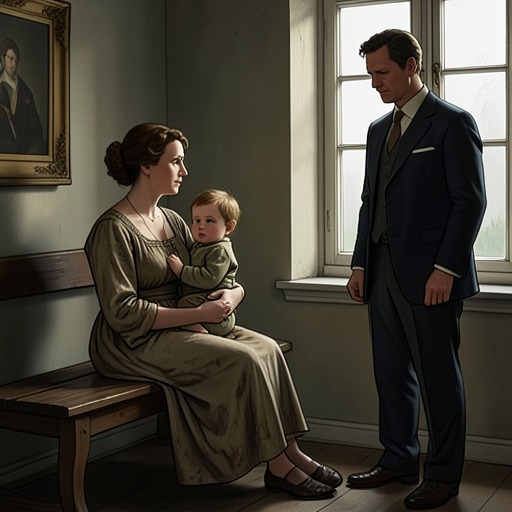
Viktor visits whenever he can, but Hana’s care becomes the defining human presence of the crisis. Her sustained attention surprises him: she proves to be more than a fair-weather friend. When Liesel is recovering enough to receive visitors, Viktor admits that he almost feels Hana is part of the family and that he does not know how he would have managed without her. The illness thus tests their friendships as well as Liesel’s physical survival, making Hana’s practical devotion unmistakable.
Recovery and Changed Perceptions
Recovery is slow. Liesel returns home tall and gaunt, still weakened enough to need a nurse. Viktor gives up his dressing room as a bedroom so that Liesel can rest undisturbed and the nurse can care for her. By day, Liesel walks through the open spaces of the Glass Room; at night, she lies still beneath a sheet. The people around her treat her like someone returned from the dead, while she sits beside Martin’s bassinet and looks out through the great windows with the distracted air of a person unsure of her surroundings. Her voice, too, has changed, becoming soft and melodic.
The baby’s feeding makes the limits of Liesel’s recovery concrete. Martin nuzzles at her breast, but there is no milk, and a nurse takes him away when he begins to cry. The moment places the demands of infant care alongside Liesel’s convalescence: motherhood continues while her body is still recovering from a life-threatening illness. The scene does not present recovery as an immediate return to the life that preceded the birth.
Coming close to death changes how Liesel speaks about the people around her. She tells Viktor that she almost left him and asks what he would have done without her. He has no answer. Liesel then imagines that he might have turned to Hana, whose shared interests in modern art, music, and literature could have made her an ideal companion. Viktor rejects the suggestion and calls Liesel his ideal, but her reply carries irony and bitterness. Their exchange leaves the question of Hana’s place in the marriage unsettled rather than dissolving it with reassurance.
Hana, Friendship, and Suspicion
Liesel’s dependence on Hana sharpens a tension already present in her friendship with her. While recovering in hospital, Liesel warns Viktor that Hana might seduce him, despite being her closest friend. Viktor is horrified by the suggestion and insists that he regards Hana like a sister. Liesel counters that he should not assume fraternal affection would protect him, and imagines Hana treating such a relationship as something she could openly share with her. Her suspicion coexists with her recognition of Hana’s genuine loyalty: the friend she fears might cross a boundary is also the woman whose care helps sustain her through the crisis.
The illness also gives Liesel a new vantage point on the future she might have left behind. Her speculation that Viktor could have chosen Hana is not simply a warning about attraction; it acknowledges how well the two might have suited each other in ordinary life. Yet the possibility remains hypothetical. The evidence establishes Liesel’s perception and Viktor’s denial, not a change in the actual relationship between Viktor and Hana during her illness.
Lasting Effects on the Marriage
In spring, Liesel and Viktor return to Venice for their first holiday alone since Ottilie’s birth. They stay in the same hotel suite as on their honeymoon, an attempt—never spoken aloud—to recapture the past. The familiar setting makes the difference between then and now legible. Their affection remains calm, but a new remoteness has entered it, perhaps connected with the difficult birth and illness, perhaps with Viktor’s own inward distance. The narrative leaves the cause uncertain while making the change in their relationship clear.
Their physical intimacy has also altered. Where the honeymoon had brought Liesel to a vivid, unrestrained response, in Venice sex now seems to disturb her being only slightly. The narrative considers whether this marks a familiar passage in a maturing relationship, with love settling into affection and desire into placid contentment. The illness does not by itself explain every change between the couple, but its aftermath stands beside the contrast between the remembered honeymoon and their quieter return. Survival restores Liesel to home and family; it does not restore their marriage to its earlier intensity.